

Issue 9: Biodiversity Loss → Financial Risk | Financial Activity → Biodiversity Loss


Welcome back to Fed Lit, our monthly newsletter profiling emerging climate analysis for macroeconomists and others seeking to understand the effects of climate change, environmental degradation and energy sources on economic performance.
“Biodiversity loss and financial stability as a new frontier for central banks: An exploration for France” by Paul Hadji-Lazaro, Mathilde Salin, Romain Svartzman, Etienne Espagne, Julien Gauthey, Joshua Berger, Julien Calas, Antoine Godin, Antoine Vallier
After a brief hiatus, we are back! This time to discuss a new (to Fed Lit) source of concern for financial stability that is gaining some traction with central bank authorities: biodiversity. Last month the European Central Bank hosted a Climate, Nature and Monetary Policy Conference to explore, among other things, the effects that environmental degradation and biodiversity loss pose to economic performance. Different environmental effects — like water scarcity, changes in pollinator activity, the over exploitation of natural resources including forests and the over fishing of oceans and rivers, the disruption of natural cycles — can alter the transport of materials, the ability to work, the cost of inputs relevant to supply, and other determinants of economic performance. This broader category of “nature” impacts goes beyond the direct impact of global warming, with various incompletely considered consequences. Nature encompasses the multitude of “ecosystem services” that underlie financial transactions.
The paper we profile today aims to demonstrate how biodiversity loss can be a source of financial risk, and also how the activities facilitated by the financial sector can in turn contribute to biodiversity loss. This bi-directional analysis — referred to as “double materiality” — reflects a dynamic reality of financial activity that is rarely integrated into central bank policy. The Network for Greening the Financial System calls upon central banks to adopt a ‘double materiality’ framework, which is to acknowledge both that climate and nature present risks to financial stability, and that financial activity contributes to the acceleration of those same risks. This paper, “Biodiversity loss and financial stability as a new frontier for central banks: An exploration for France”, takes an important step in this direction by exploring the extent to which French financial institutions in particular are both exposed to biodiversity loss, and contribute to it.
Key Findings
In 2019, 42% of the portfolio value of securities held by French financial institutions which collectively held assets of approximately $995 billion euros, were issued by “physically high-stake firms” — firms that are highly or very highly dependent on one ecosystem service or more. These holdings are thus at risk of devaluation should ecological conditions change and inhibit the provision of reliable ‘ecosystem services’ to support the issuing firms’ operations.
The biodiversity impact of the total portfolio held by these same French financial institutions in ecological terms is equivalent to the destruction of at least 130,000 square kilometers (80,870 square miles) of pristine nature.
33% of the portfolio value held by these same French financial institutions is exposed to firms whose upstream value chains have substantial impacts on biodiversity, and are thus reliant on “transition high-stake” firms. Their transition risk implies that should policy be enacted that curbs firms’ ability to impact biodiversity, the supply chains to issuing firms could be significantly disrupted.
Why it Matters
These results suggest that by virtue of their portfolios, financial institutions are both vulnerable to biodiversity loss and implicated in the destruction of biodiversity. This makes them vulnerable to both climate driven physical shocks to biodiversity, and to transition shocks that come from policies that speed up or slow down biodiversity loss.
Biodiversity loss, like climate change, in many cases creates irreversible losses or costly mitigable losses. Shocks to particular ecosystems could result in fundamental changes to firms’ ability to thrive, or send entire sectors into financial distress which in turn implicate institutional investors through sudden asset value changes.
Biodiversity losses exacerbate climate change and vice versa: As natural ecosystems are disturbed, their capacity for absorbing carbon and greenhouse gas emissions is reduced, thus magnifying the impact of climate change. At the same time rising temperatures contribute to drought, extinction, and rising sea levels, thus worsening biodiversity loss. Losses are dynamic in both directions.
An expanded understanding of nature’s contribution to economic activity, profits, returns, and thus the stability of the financial system is critical for anticipating crises and designing policies that have consequences on biodiversity.
Is this Fed Business?
Central banks, including the Federal Reserve, should monitor the extent to which biodiversity loss can alter the strength of firms in particular sectors like agriculture, chemical production and manufacturing, by observing credit delinquencies, defaults, asset price drops, and other signs of financial instability.
Central banks, including the Federal Reserve, should assess the likelihood of these biodiversity risks using stress-testing.
Central banks, including the Federal Reserve, should also be aware of the environmental impact of firms that are borrowers or beneficiaries of discount window loans, emergency loans or other bail out extensions. For example, when central banks purchase shares in firms that are “physically high stake” and highly vulnerable to ecological shocks — or take collateral of such firms — their actions expose the central bank’s balance sheet to taxpayer loss, and also falsely signals to other financial institutions that these loans are adequately collateralized, or that the securities of these firms are otherwise valuable.
On the other hand, when central banks, including the Federal Reserve, invest in “transition high-stake” firms — or firms that have a large environmental impact — the central bank is implicated in contributing to ecological collapse, and is vulnerable to asset devaluation if legislation or regulation is enacted that alters firms’ biodiversity impact.
A Closer Look at the Research
The authors acknowledge that the costs associated with biodiversity loss are complicated and unpredictable, and thus challenging to measure holistically. So they do not attempt to predict the nature and likelihood of biodiversity loss in this paper ; instead they take the approach of quantifying financial exposure to the risk of potential biodiversity loss. In doing so they provide a sensible starting point for stress testing the financial system against various ecological scenarios that can be applied to events in different countries, sectors or geographies.
They focus on securities held by French financial institutions (FFIs) at the end of 2019 and cull the data to include only three sets of securities — securities that are publicly listed, short term debt securities, and long term debt securities. This inclusion of three sets of securities provides data that covers 995 billion euros in securities held by 1126 issuing firms. They note, appropriately, that commercial banks are underrepresented in this data set because so much of the asset side of their balance sheet is made up of loans — 37% — and only 9% of their assets are in debt holdings or securities. This point reveals that their analysis of biodiversity risk exposure is dependent on the mix of French financial firms that have been analyzed and could lead to underestimates of the extent of financial sector exposure. For example, the authors do not study the extent to which financial stability is threatened through loans made by commercial banks that extend credit to ecologically vulnerable firms or projects.
Biodiversity Dependency
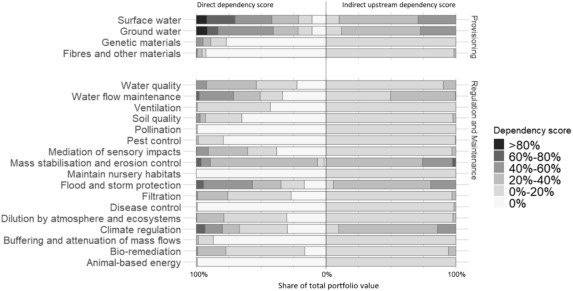
After culling the data set, the authors next analyze the issuing firms included in their data to determine the ecological vulnerability of the FFIs to the issuing firm. The authors group the issuing firms by sector and geography and then assess their vulnerability using both EXIOBASE, an input-output table that provides information about the value chains for each sector and ENCORE, a database that connects production processes with the “ecosystem services” they require. From here, the authors assign each sector, and then each issuing firm in that sector, a “dependency score” on a given ecosystem service.
With this method they find that the ecosystem services leading to the highest dependency scores are those that use, require or involve surface and ground water; those that require erosion control; and those that require flood protection. They find that all firms in the portfolio are slightly dependent on all ecosystem services through their supply chains.
For example, the black portion at the top of the left column of this chart indicates that about 5% of the market value of securities in the portfolio of FFIs were issued by companies that are very highly dependent (dependency score > 80%) on surface water.
Biodiversity Impact
The authors then aim to quantify the impact that French financial institutions can have on biodiversity loss – what they call or their “static terrestrial biodiversity footprint”. They find that as of the end of 2019 the securities in the FFI portfolio were responsible for the equivalent of turning 130,000 square kilometers of pristine nature into a completely artificial area. The biodiversity drivers of this conversion were through changes in land use and the encroachment of natural habitat. The authors found that the majority of these impacts came from upstream suppliers to the issuing firms in the FFIs’ portfolios rather than the issuing firms in the portfolio themselves. This presents a transition risk to the issuing firms because biodiversity protection policy could create a negative supply shock for key inputs critical to issuing firms’ revenue generators.
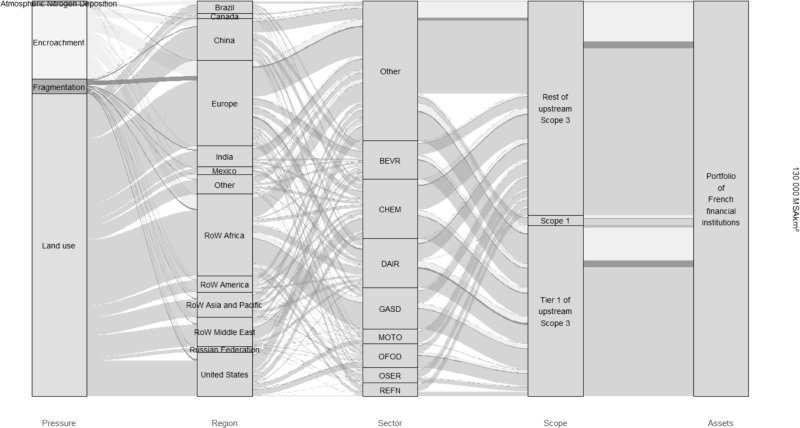
Starting from the right hand side of this graphic, we can see how few of the FFI firms fall into Scope 1 environmental impacts — those that come from the direct activities of the FFI firms — and that the majority of impacts come from Scope 3 that stem from FFI firms’ supply chains. On the far left of the graphic we can see that these upstream activities overwhelmingly result in land-use impacts, largely in Africa, Europe, China, and the United States.
We can also see from the middle column that the biodiversity impacts stem predominantly from chemical production, dairy products, gas production, beverages, and “other” food products. While food and dairy exhibit the largest biodiversity impacts, they represent a smaller fraction of the FFIs’ securities portfolios. Chemicals and gas production have less land-use impact, but make up 12% and 4% respectively of the FFI portfolio.
These findings are important inputs into policy design, including narrow policies that aim to curb biodiversity loss. For example, applying hard constraints on land use for food production could be potentially devastating for the sector if there is no adjustment by the financial sector of the effects of these policies on their portfolio values.
Stress Testing
While the authors do not, as they acknowledge, conduct stress tests based on forward looking biodiversity loss scenarios, their analysis provides the scaffolding for future work to do just that. Their assessment of the vulnerability of French financial institutions is critical for central banks to be aware of and monitor closely. Especially in highly impacted geographies, dramatic changes in biodiversity can occur within a season or a year, not decades, especially when it comes to water supply. With all financial firms depending in some way on one or more ecological services, this paper reveals how vulnerabilities can accrue and compound from a disruption in nature’s provision of services.
Stress tests can also be useful to understand the impacts of policy aimed at preserving nature, not exclusively because their findings might deter dividend payments and other actions, but so that additional stabilizing measures required for particular sectors or geographies can be considered by the financial sector.
The Federal Reserve attempted a short pilot effort to conduct a narrow climate scenario analysis that has since been discontinued. When these efforts are restarted, they will need to include biodiversity financial risk assessments. The Fed is far behind its counterparts: the European Central Bank, Banque de France, Bank of England, Peoples Bank of China and Banco d’Éspaña, all regularly conduct climate stress tests. The Banque de France and the Nederlandsche Bank are up to speed, having incorporated in their stress testing regimes biodiversity risk research similar to this reviewed research. Critically, the Banque de France and the ECB have gone further, embracing “double materiality,” a formal acknowledgement that financial sector activity is not just at risk from climate or biodiversity loss, but also a driver of these same outcomes.
To cite this paper:
Hadji-Lazaro, Paul, Mathilde Salin, Romain Svartzman, Etienne Espagne, Julien Gauthey, Joshua Berger, Julien Calas, Antoine Godin, Antoine Vallier. 2024. “Biodiversity loss and financial stability as a new frontier for central banks: An exploration for France” Ecological Economics 223, no. 108246. https://doi.org/10.1016/j.ecolecon.2024.108246